Marco Di Caprio has always been deeply engaged in cultural research, a vocation rooted in his humanistic education and enduring interest in the relationship between literature, music, and emotional consciousness. His principal fields of study are popular music and medieval lyric poetry, which he approaches through an interdisciplinary perspective that combines philology, symbolism, aesthetics, and cultural history.
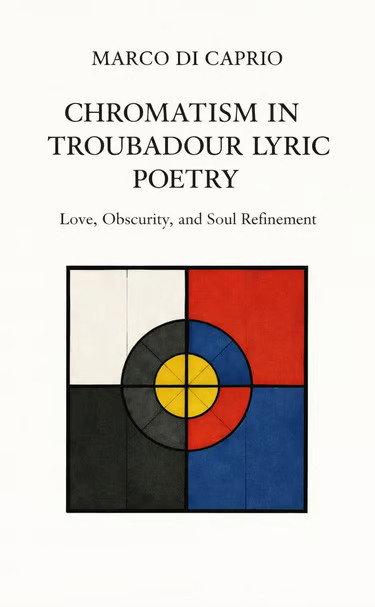
A central dimension of his scholarly work is the study of chromatism in Troubadour lyric poetry. In his academic book Chromatism in Troubadour Lyric Poetry – Love, Obscurity, and Soul Refinement, Di Caprio proposes an original interpretation of light, darkness, and color in the poetry of the troubadours—the singer-songwriters of southern France in the twelfth century. Rather than treating chromatic imagery as merely decorative, he interprets it as a symbolic and spiritual language expressing the inner dynamics of Love: desire, obsession, pain, longing, healing and transcendence.
Through close readings of major troubadour poets, his research shows how chromatic symbolism reflects a psychological and moral journey in which courtly love becomes a path of soul refinement and metaphysical elevation. By situating medieval lyric within a broader continuum that connects poetry, music, and emotional perception, Di Caprio offers a renewed understanding of troubadour poetics and demonstrates their continuing relevance for modern reflections on love, artistic expression, and human consciousness.

Another important area of his cultural research concerns the British rock band The Beatles. Di Caprio has developed an extensive alternate discography imagining that the group never disbanded in 1970 and extending their creative trajectory until 1980, the year of John Lennon’s death. Constructed from the solo works of the four members and re-conceived as collective albums, this project explores how the band might have achieved an even greater artistic and cultural influence had they remained united until the end of the decade.
He is also planning a critical study titled The Beatles and Love Desire – From Love Me Do to I Want You (She’s So Heavy), intended to trace the musical and emotional evolution of the band’s songwriting. In this work, Di Caprio argues that the Beatles’ lasting importance lies not only in technical musical innovation but in their capacity to expand the horizons of emotional and inner consciousness through concise and universally resonant song forms.
A further strand of his research is dedicated to the British singer-songwriter Robbie Williams. Often underestimated as merely an entertainer, Williams is reconsidered by Di Caprio through an alternative discographic reconstruction based on hidden or marginal material—particularly B-sides—revealing a deeper artistic coherence and suggesting that a different curatorial approach to his albums might have led to a broader critical recognition of his cultural significance.
Across these diverse fields, Marco Di Caprio’s work is united by a single guiding intuition: that poetry and music function as symbolic languages of the inner life, capable of revealing connections between aesthetic beauty, emotional experience, and spiritual meaning. His research therefore seeks not only to interpret cultural works but also to illuminate the ways in which art refines perception, deepens consciousness, and gives enduring form to human desire.
 Marco Di Caprio