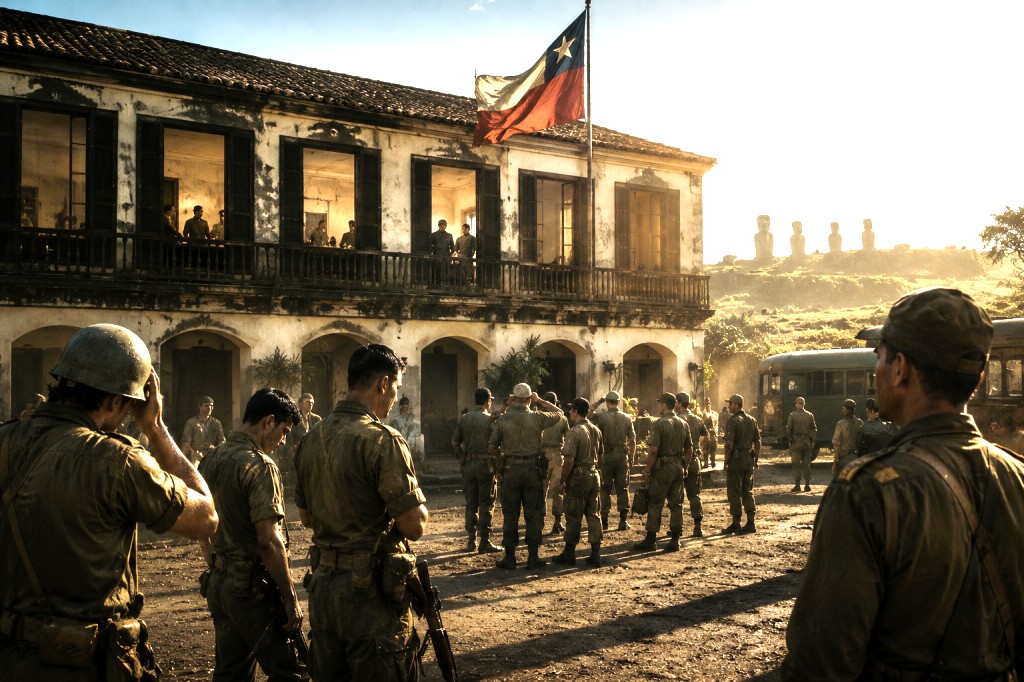
The Chilean governor’s palace in the capital of Hanga Roa had never seemed so large. Rooms echo differently when authority dissolves. The high ceilings, once reassuring, now amplified every step.
Outside, in the courtyard, the soldiers stood in formation beneath a sky too bright for a departure. Their uniforms clung to their sweaty backs. Rifles hung low. No one spoke loudly. Boots shifted over the gravel. Dust lifted and settled again.
They were waiting to leave.
Years of patrols. Years of clashes. Years of men buried.
And now, the withdrawal.
Inside the administrative wing, clerks folded maps with slightly trembling hands. Official seals were wrapped in linen cloths. Files packed into wooden crates. The Chilean flag in the main hall had not yet been lowered, but everyone had already imagined the moment when it would descend.
The decision had arrived like a distant telegram, almost from another planet.
The president in Santiago had chosen to retreat.
Independence for Easter Island. Peace, they called it.
Abandonment, others whispered.
Some members of the Chilean elite had been born on that island. Their fathers had worked the land. Their mothers had married into local families. They did not feel like occupiers. They felt like uprooted heirs. They no longer knew where Chile ended and Rapa Nui began. And now they were being ordered to leave.
In the governor’s sitting room, heavy curtains filtered the afternoon light into amber shadows. War relics covered the walls. Framed photographs of ceremonies, medals, uniforms polished for parades long past. Golden ornaments that now seemed almost theatrical.
The men seated in a circle no longer looked ceremonial.
They looked tired.
The governor paced slowly back and forth instead of raising his voice. His face was no longer flushed as it once had been. Now it was pale. Controlled.
“We are withdrawing,” he said at last, as if the word itself tasted bitter. “Orders from Santiago.”
A colonel leaned forward.
“With respect, sir, we were born here. Some of us have mixed blood. We are not Chileans stationed abroad. We are from Rapa Nui. This is home.”
Silence followed.
The Chilean general sitting near the window watched the courtyard below. He saw soldiers adjusting their caps, wiping sweat from their necks.
“We should not leave,” he said quietly. “We should declare independence ourselves.”
The idea hung in the room. Not a rebellion. A reconfiguration.
Another officer exhaled slowly.
“And with what funds? Santiago has cut everything. Supplies. Reinforcements. They are dismantling us.”
“The Americans,” someone murmured.
The word altered the air.
The governor stopped.
“Yes,” the general continued. “The Americans will not allow instability in the Pacific. They will invest. Facilities. Infrastructure. Security.”
He turned.
“But we need a political figure. Someone who can serve as a bridge between us and Washington.”
The name emerged slowly.
“Sergio Rapu.”
The governor frowned.
“That mixed-blood merchant?”
“He speaks English,” the general replied. “He has contacts. He has met officials in the United States. If President Nixon sees an opportunity here, the funds will come. And the weapons.”
The governor walked toward the window. Outside, a soldier removed his helmet and wiped his face. Another adjusted the strap of his rifle.
“You are proposing,” he said slowly, “that we stay. That we refuse Santiago. That we align ourselves with Washington.”
No one answered immediately.
It was not betrayal, they told themselves.
It was pragmatism.
“We were not defeated,” the officer insisted. “We are being handed over.”
The governor’s jaw tightened. Years of reports. Lists of the fallen. Fires in indigenous villages. Negotiations. Promises made and broken.
All erased by a signature in Santiago.
“And Rapu?” he asked at last.
“He will lead the transition,” the general replied. “He will declare independence. We will remain as protectors. The Americans will stabilize the rest.”
The governor looked back out at the courtyard. The soldiers were still lined up, waiting for buses that had not yet arrived. He imagined telling them to stay. To remove the Chilean insignia. To replace one flag with another.
The palace suddenly seemed fragile.
A breeze stirred the curtains. For a moment, the room seemed to breathe.
“And if the natives rebel?” a lieutenant asked quietly.
“They are already restless. I’ve heard they are receiving help from the Russians,” another officer said.
“Yes, the Russians are supporting them,” the general replied. “And that is precisely why we cannot create a vacuum.”
The governor closed his eyes briefly. He had never imagined his career would end in retreat. He had imagined medals. Recognition. A dignified transfer back to Santiago.
Instead he was being asked to choose between obedience and reinvention.
Outside, an order was shouted. The formation shifted. The sun had dipped slightly, but the heat remained.
“Very well,” the governor said at last.
Not loudly.
“Inform Rapu.”
The men in the room did not celebrate. They did not smile. They simply straightened in their chairs, as if history had leaned forward and they had chosen not to step aside.
Outside, the line of soldiers began to dissolve, not yet dismissed, not yet departing but uncertain of their destiny.
The flag above the palace fluttered once in the wind.
And for the first time that afternoon, no one was entirely sure which nation it still represented.
 Marco Di Caprio
Leave a comment