I
In the ghetto of Rongo, near the capital of Hanga Roa, the air carried no silence.
It carried trills and rolling drumbeats, shouts that broke into laughter, laughter that turned into song, songs that echoed with the drums, as if the island had found a single heartbeat and decided to follow it. The heat made everything brighter and harsher, yet the people danced anyway. They danced in the dust. They danced in the glare. They danced as if the sun were not an enemy but a witness.
Bare-chested men, their arms painted, moved in circles. Women, naked or nearly so, wove flowers into one another’s hair and raised their hands toward a sky that had never signed a treaty with them. Children ran between the legs of dancers and the drums, half lost, half possessed by the music. Someone blew into a conch shell, and the sound crossed the square like a call older than politics.
The ghetto was poor.
But that morning it seemed alive.
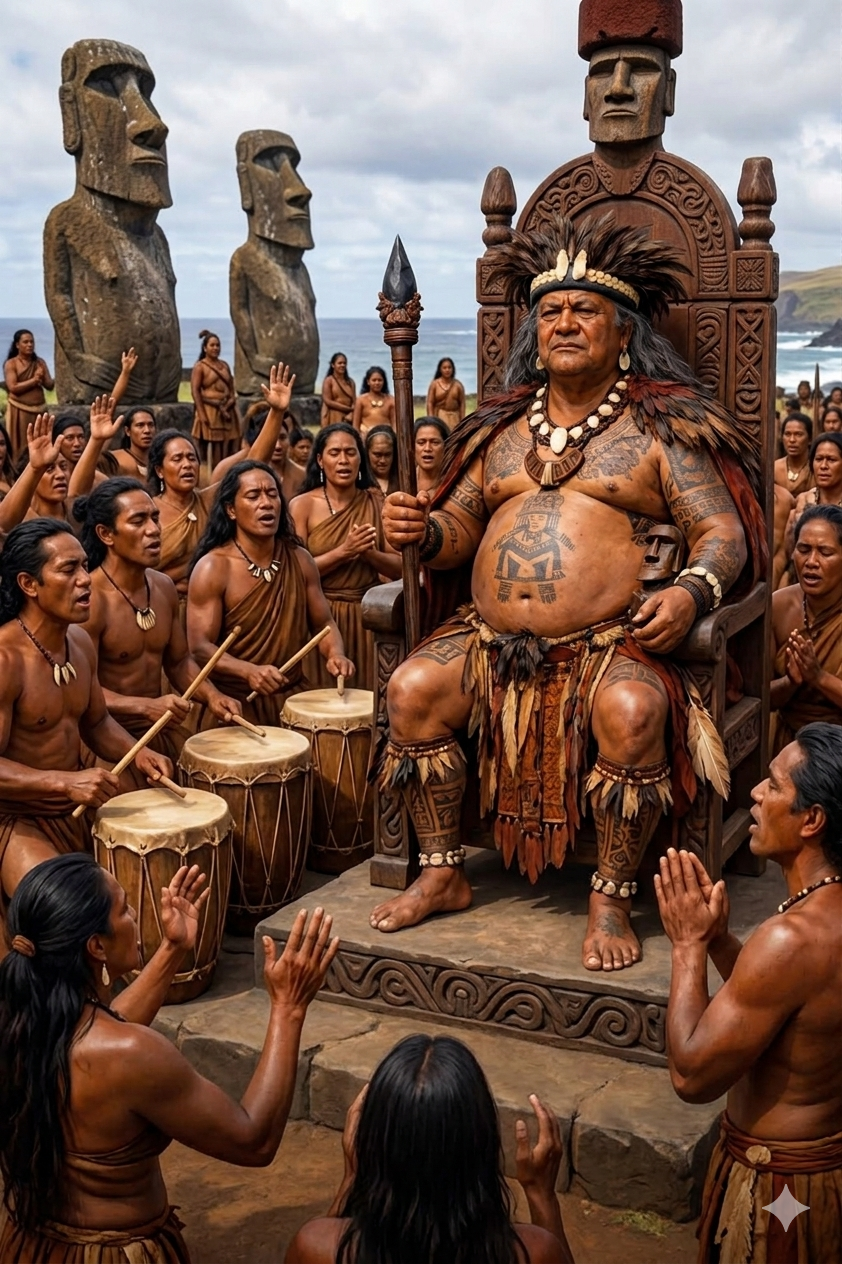
And at the center, the great king Hotukau sat on a plain chair set as a throne.
He was a large man, heavy in the way old fighters become heavy, not only in flesh, but also in memory. His belly rose and fell like a slow tide. His skin was dark, not from idleness but from a life beneath the open sky. His long gray hair fell over his shoulders like a cloak. He wore ornaments that looked simple to foreign eyes and sacred to the eyes of the island. Rings dulled by salt. A pendant that had once rested against the chests of men who died in battle.
One servant held a bottle. Another a cup. Hotukau sipped a sweet fermented drink, too warm, and watched his people celebrate. He smiled. For a moment the smile seemed sincere. Then it stiffened, not into cruelty, but into vigilance.
Because joy is dangerous.
Joy softens the edges of survival.
Joy makes one forget that history does not end when a flag changes.
“Freedom!” the crowd shouted.
“Freedom!”
Hotukau listened to that word the way one listens to a tool that can cut or heal, depending on who holds it.
He had fought all his life. Not metaphorically. In mud. In smoke. In hunger.
He had seen brothers die with their eyes open, not turned toward heaven but toward the face of a soldier who did not hate them personally and killed them anyway. He had seen women dragged by the wrists like sacks of grain. He had seen young men beaten for laughing too loudly, beaten for not bowing quickly enough, beaten because someone in an office needed to remind the island that obedience could be enforced.
He had seen his own house burn.
He could still smell it. The wood cracking. The flames devouring the roof like an animal. The sky turned into a ceiling stained with smoke. His mother screaming. A hand pulling him back violently. His father standing in the doorway. Old even then. Sick even then. Every morning he spat blood and still went out to sea. He returned with sardines and tuna as if the ocean were a faithful friend and not an indifferent god.
In Hotukau’s mind his father had been the master of life itself. Wisdom embodied. Justice for the weak against the strong. Then he saw the room burning and wisdom turning to foam at the mouth.
“Go,” his father had said, his voice torn.
“Go, Hotukau.”
And he had wept.
Hotukau had never seen his father cry.
So he ran.
He ran with his cousins, with boys who became men too quickly. They drank rainwater mixed with saltwater. They hunted horses against the will of God and tradition, because hunger is holier still.
Years later they called him Majesty and imagined he had been born with authority.
He became hard because softness was not safe.
He became a strategist because innocence had been punished.
He served in the militias of King Raraku. When Raraku died without heirs, the elders looked around and saw a man who had survived what should have killed him.
So they named him king.
Almost thirty years earlier.
Now he watched his people dance and felt tenderness. Then fear. Because celebration makes one visible. And visibility attracts predators.
A messenger pushed through the crowd. They called him the ambassador, a title stitched together by necessity. Thin, nervous, always slightly out of breath.
He bowed.
“My lord, I have important news.”
Hotukau was not surprised.
“The Chilean dissidents have moved. A businessman, Sergio Rapu, has taken command. He wants to proclaim independence.”
Independence.
On the lips of the islanders it tasted like redeemed blood.
On the lips of foreigners it tasted like a contract.
Sergio Rapu.
A man who spoke of progress as if progress were a god.
A man who could sit with Chileans and Americans and claim to represent the island.
Hotukau did not care about mixed blood. He cared about loyalty. About memory.
Rapu was not aligned with the island’s pain.
He was aligned with profit.
“Take up arms,” he ordered quietly.
He rose. When he rose, his heaviness became authority.
“Death to Sergio Rapu.”
The chant spread like fire. Some repeated it. Others hesitated.
Another rifle shot echoed in the distance.
II
The governor’s palace was in chaos. Soldiers were fighting one another. Balconies were occupied. Smoke hung in the air.
Hotukau arrived at a distance. He saw the governor’s wife on the balcony. He saw the shot. The fall.
No grace. Only gravity.
Inside, the governor was shouting into a telephone that returned only silence.
Then he saw Sergio Rapu enter the courtyard. Confident. Theatrical.
“Long live democracy!” he shouted. “Long live freedom!”
He raised a blue flag with a star.
“Long live the Republic of Rapa Nui!”
The governor stepped outside with a pistol. He searched for Rapu with wounded eyes.
A rifle pressed against his temple.
“It’s over, Governor.”
Hotukau watched from the shadows. He saw the old monster wounded. He saw the new monster being born with different words.
Freedom. Democracy.
Easy words.
Who would own the island tomorrow?
He returned to the ghetto. The drums resumed, but harsher now.
He climbed onto a stone.
“My people,” he said, his voice hoarse and deep, “you celebrate too soon.”
A murmur spread through the crowd.
“They change the flag and speak of democracy as if it were a god.”
Silence.
“Freedom is not a gift.”
His voice sharpened.
“Freedom is taken with hands and with blood. No one will give it to you.”
Some nodded. Others trembled.
“Sergio Rapu is not your king. He is not your father. He is not your ancestor. He is a merchant.”
A wave of anger moved through the crowd.
“He will promise you houses. He will promise you wages. He will promise you radios and televisions. He will promise you the world. But he will not give you freedom.”
He leaned slightly forward.
“And then he will sell the island to those who financed his flag.”
Silence.
He did not finish the thought.
There was no need.
The drums resumed. Different now. Less joy. More war.
Hotukau walked among his people, feeling the weight of the past settle on his shoulders like a cloak.
Once, he had wanted peace. Before the fire. Before hunger. Before the tears of his father.
But peace had protected no one.
The sun continued to blaze over Hanga Roa.
Hotukau lifted his gaze toward the distant palace.
History was not ending.
It was only changing its mask.
And he would not allow the island to be deceived again.
Not while he was alive.
 Marco Di Caprio
Leave a comment