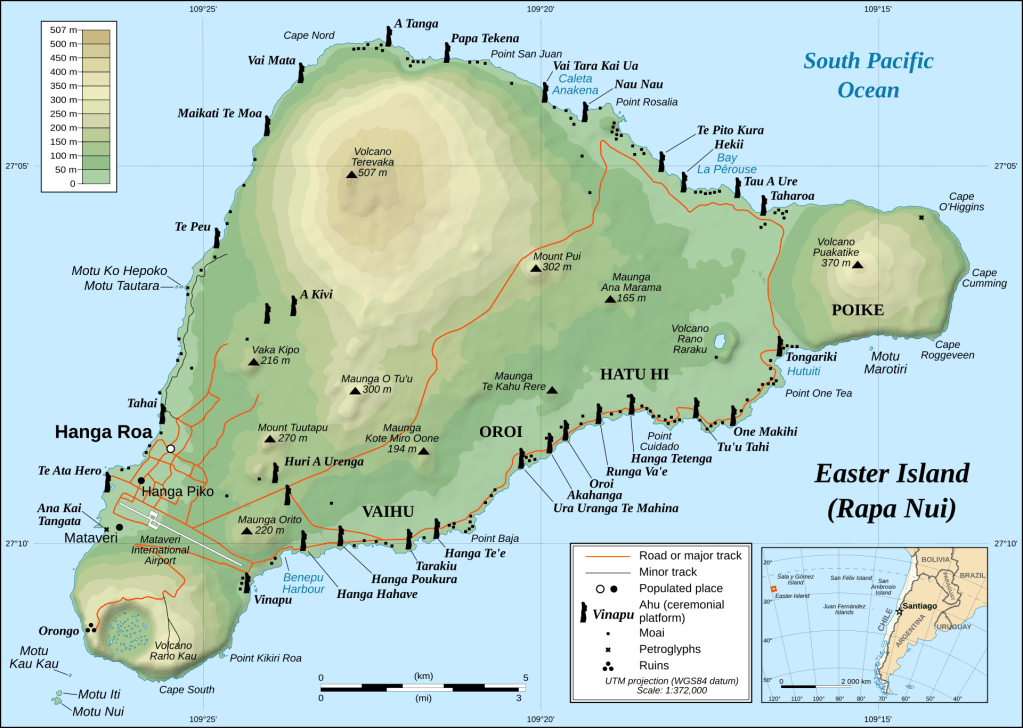
In the vast and restless Pacific Ocean lies an island that seems to have been forgotten by time. The island is known as Easter Island, but to those who belong to it, it is Rapa Nui: the Great Rock.
Remote, wind-carved, and solitary, it rises from the ocean like the back of a sleeping giant. Three ancient volcanoes dominate its profile, and the tallest among them, Cerro Terevaka, keeps silent watch over grassy plains and scattered villages. Hanga Roa, the modest capital, rests beside the sea, where the waves repeat an endless litany against the cliffs.
Yet what gives Rapa Nui its haunting presence are the moai, colossal figures carved from volcanic tuff. Their empty gazes seem to guard secrets too ancient to be spoken. They are believed to embody the spirits of the ancestors of the Rapanui people, a Polynesian civilization that once flourished in isolation.
History was not kind to them.
And yet they endured.
They continued to speak their language, Rapanui, even as Spanish reshaped its sounds and bent its grammar. The ancient writing system known as Rongorongo, once carved into memory and wood, sank into silence. Epidemics and forced labor had thinned the population so brutally that knowledge itself became fragile. It is said that those who survived were not always the ones who knew how to write.
But tradition proved more resilient than power had expected.
The Chilean administration did not extinguish the ancient beliefs. Nor did the earlier Spanish missionaries succeed in erasing them completely. Christianity arrived, and Christ entered their prayers, yet the old gods did not disappear. They transformed. They endured. The Rapanui placed the Christian God beside their ancestral spirits, weaving the new faith into the fabric of older cosmologies. Their religion did not vanish; it adapted.
On Rapa Nui nothing was ever entirely replaced.
It was absorbed, transformed, remembered.
Today, alongside the islanders, there is another presence: International scholars. Linguists, anthropologists, archaeologists, all drawn by the enigma of a civilization that seems suspended between myth and ruin. They attempt to reconstruct a past preserved mostly through oral tradition. Among these traditions circulates a legend.
It speaks of a sacred relic, not a treasure of gold, but something known simply as “the Mystery.” Indigenous priests often mention it, whispering that it holds the key to understanding not only their history, but the destiny of humanity itself.
Many have searched for it. Few truly understand what they are looking for.
 Marco Di Caprio
Leave a comment