I
The heat entered the archaeological center before they did.
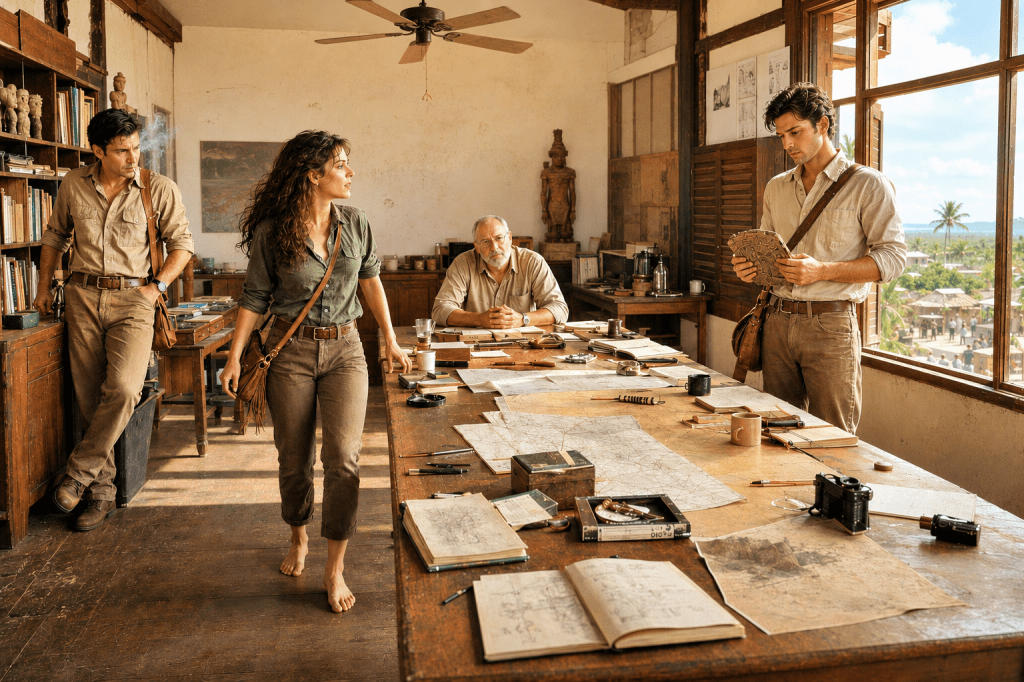
It slipped through the shutters, pressed against the glass, settled over the papers. The common room smelled of dust, tobacco, and old wood swollen with humidity. Maps were scattered across the long table. Pencils rolled slowly whenever the fan vibrated too strongly.
No one was sitting comfortably.
Mario stood near the window. From there he could see the road sloping down toward the lower part of the town, where movement had become more frequent, less casual. Men gathered at corners. Women in tight circles. The air was charged, even without noise.
Alicia paced back and forth. She had taken off her sandals and walked barefoot across the wooden boards, her steps sharp and impatient.
“So this is what liberation looks like,” she said. “Finally.”
Mario did not turn.
Jerry sat on the edge of a desk, leaning against the wall. One leg crossed over the other. A cigarette between his fingers. He exhaled slowly, almost meditatively.
Patrick remained seated at the table, hands folded, shoulders slightly bent forward. In the heat he seemed older. Not weaker but more burdened.
“I don’t believe in freedom,” Mario said quietly.
“You’re afraid of change. At least it won’t be Chile governing anymore,” Alicia shot back.
“And what will it be?” Mario replied.
“Elections.”
Mario held her gaze.
“You trust slogans too easily.”
“And you distrust everything.”
Patrick cleared his throat.
Then he spoke calmly. “The island is in transition. And that alone carries danger.”
Alicia turned toward him.
“Danger for whom? For us?”
“For everyone,” he answered gently.
Mario stepped away from the window.
“You think this won’t end peacefully, Professor?” he asked.
Patrick did not answer.
Jerry tapped ash into a ceramic bowl.
“No, it won’t end peacefully. But we are protected by the American government. It’s not our affair,” he said calmly.
Alicia looked at him.
“And what is our affair?”
“We shouldn’t let external factors influence us. What happens on the island is an external factor. Peace has to exist inside us,” Jerry replied flatly.
The room fell silent.
Outside, a truck passed quickly. The shutters rattled.
Alicia crossed her arms.
“How is it possible not to be influenced by external factors?” she burst out, irritated.
Patrick raised a hand.
“That’s enough.”
His voice was gentle but authoritative. Mario looked away. Alicia turned toward the opposite wall.
Patrick continued.
“The Chileans are leaving. That much is certain. What will replace them is not yet defined. We are not judges. We are witnesses.”
A telephone rang in the corridor. The sound was thin, almost hidden beneath the hum of the fan.
Jerry jumped up.
“I’ll answer.”
He left without hurry. The door closed softly.
The room changed.
Mario moved unconsciously toward the door, stopping before touching it. Through the thin wall only fragments could be heard. A woman’s voice. Calm. Controlled. American.
Jerry’s tone did not grow warmer or colder.
It became more precise.
“Yes… I know… No, not yet… I understand… I’ll call you back…”
Alicia noticed Mario listening.
“Don’t eavesdrop,” she said.
“I’m not doing anything.”
“You are.”
Mario stepped back.
The door opened again. Jerry returned. His face slightly pale.
“Everything alright?” Patrick asked.
“Yes,” Jerry answered calmly. “Personal matters.”
His hand was trembling.
He sat down again. The fan continued turning. Outside, voices were rising in the distance, not yet shouts, but no longer casual.
Alicia moved toward the window.
Mario met her gaze.
Her vitality unsettled him with envy.
Patrick watched them both.
“I want what’s best for the islanders,” he said slowly. “Not for Santiago. Not for Washington. Not for an ideology. For them.”
He paused.
Alicia’s shoulders lowered slightly. Mario held his tongue, caught between two answers that were both true.
Jerry crushed his cigarette in the bowl. His hand was still trembling.
“We should avoid public statements,” he said. “At least for now.”
“Why?” Alicia asked.
“Because we don’t know where all this is going. I recognize instability when I see it.”
Silence. The fan turned. The heat pressed in.
Alicia picked up her sandals.
“I can’t stay here,” she said. “It feels like the walls are closing in.”
She left. The door closed.
Patrick remained seated, hands folded. Jerry went to the window. Mario stood still, his gaze distant.
He had the strange sensation that Hanga Roa was not a place he was looking at, but a place he was looking from, as if the town’s quarrels were somehow already inside him, old arguments he had never resolved.
The mixed feelings of the island had entered that room and they were beginning to divide them.
No one had drawn a line.
But the line existed.
II
Professor Patrick Ford remained seated for a long time after Alicia had left.
The room had grown quieter, but not calmer. The heat pressed down more heavily, as if the air itself had thickened with uncertainty. The fan rotated with patient indifference. Papers lifted slightly at the corners and then fell back again.
Patrick’s eyes rested on nothing in particular.
He cared. And that was his burden.
He cared about the indigenous people, not romantically, not ideologically, but attentively. For years he had listened to their stories. He had sat in their kitchens. He had walked along the coast with the elders. He had learned when silence meant distrust and when it meant dignity.
He did not see them as symbols of resistance or emblems of liberation.
He saw them as wounded individuals.
And those who are wounded in spirit often misinterpret the intentions of others.
He was American. Same accent. Same passport. The same unspoken association with power.
Would they see archaeologists?
Or enemies?
Patrick’s fingers pressed lightly against the table.
If Sergio Rapu consolidated authority, would he protect the island or reshape it?
Would he need Western scholars or simply tolerate them?
Would they be seen as neutral observers, or convenient resources?
The funding from the Chilean government had vanished.
Gone with the flag.
Gone with the soldiers.
Gone with the bureaucracy that, for all its violence and contradiction, had at least issued checks on time.
Patrick had tried to call the University of California.
Three attempts. Four.
A secretary.
Then voicemail.
Then nothing.
The line kept dropping.
The ocean interfered with everything: signals, stability, clarity.
Their resources would last one month.
At most.
Twenty archaeologists depended on the center: salaries, equipment, housing, essential operations.
The numbers arranged themselves in his mind with cold precision. He had never loved numbers, but he respected them.
They did not lie.
His pale, strained eyes revealed darker feelings beneath them. A weariness that came from more than age.
Mario watched him carefully.
“You’re thinking of leaving,” Mario said.
Patrick did not raise his eyes immediately.
“I’m thinking about how to keep the research going,” he replied quietly.
Jerry leaned back against the wall again, arms crossed.
“Universities don’t move quickly,” he said.
“They move when reputation is at stake,” Patrick replied.
He rose slowly.
“I’m going to see Sergio Rapu.”
Mario frowned.
“For what?”
“To ask him to release the funds Chile had allocated for our archaeological research. He called me this morning. He wants to find the Mystery because it would give prestige to the new government,” Patrick replied.
A pause followed.
Mario looked surprised.
“How can the Mystery interest him while he’s managing a war?”
“International prestige matters to a newly born leader,” Jerry said calmly. “It gives him leverage.”
“Absolute control,” Mario said.
Patrick nodded slightly.
“Yes.”
He adjusted his jacket, even though it was far too hot to wear one. Habit. Dignity.
“If Rapu gives us five or six thousand dollars,” he continued, “we can maintain essential operations. For a while.”
“For a while,” Mario repeated.
“For a while,” Patrick confirmed.
Suddenly the telephone rang.
Jerry stepped into the corridor before anyone else could react. A moment later he returned.
“There’s a call for you, Professor,” he said. “From Sergio Rapu.”
Patrick stood up quickly, faster than his age usually allowed. The corridor swallowed him.
Mario and Jerry remained alone.
Jerry’s face did not change, but his hand trembled slightly.
They stayed silent.
Footsteps returning.
Patrick entered again. Something in him had changed.
It was not exactly relief.
It was something more complex.
“Well?” Mario asked.
Patrick closed the door carefully.
“Rapu has granted us twenty thousand dollars.”
Silence.
“For one month?” Jerry asked.
“For one month.”
The number hung in the air.
Twenty thousand.
It was more than Patrick had hoped for. More than they had ever received in a single month without negotiations, without obligations for lectures, without academic pressure.
Alicia reappeared in the doorway, drawn by the change in the room.
“Twenty?” she repeated.
Patrick nodded slowly.
“To cover common expenses and salaries.”
“But where did he get it?” Alicia exclaimed.
She returned to the table and sat down.
Berkeley had once offered eight thousand dollars a month for almost a year, but that money had been tied to lectures, conferences, and academic visibility. Those funds were for medieval history intersecting with Amerindian civilizations, intellectual fashions.
This was different. Fast. Clean. Unconditional.
No explicit request.
At least none spoken aloud.
 Marco Di Caprio
Leave a comment