The day after independence, the island did not feel liberated. It felt overheated. Summer was already fully awake in the Southern Hemisphere. The sky above Hanga Roa was pitilessly clear, a vast pale dome pressing downward, as if testing the endurance of men who had only just declared themselves free. In the courtyard of the former governor’s palace, preparations were underway. Not only for a celebration. For an execution.
The Chilean governor, once untouchable behind polished doors and armed guards, was now confined to a room whose windows looked out over the same courtyard where ceremonies had once been held in his honor. That evening, at sunset, he would be led outside. The drums had already begun their rehearsals. The ropes were being tested. Freedom, it seemed, required spectacle.
Meanwhile, in the ghetto of Rongo, near Hanga Roa, the heat gathered in a different way.
It settled low between the shacks, clung to the tin roofs, pressed into the narrow passageways where children watched the adults with wide, uncertain eyes. Independence had arrived, but its meaning remained unstable.
Some believed Sergio Rapu would restore dignity to the island. Others believed he would turn it into profit.
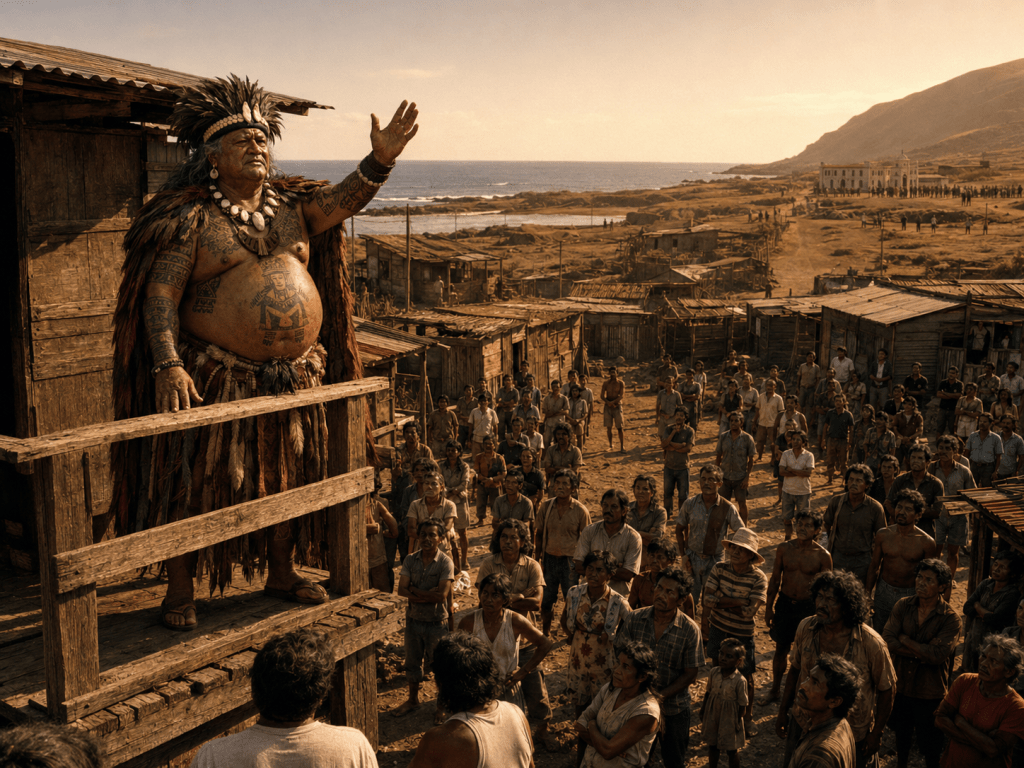
King Hotukau wasted no time. He had returned from the perimeter of the palace the night before with his face carved by shadow. At dawn he gathered his men in the common space between the wooden huts, an uneven clearing where dust rose easily and arguments could be heard from far away.
He stepped onto the small balcony attached to the shack that served as headquarters. He did not look theatrical. He looked tired. But when he spoke, the weariness sharpened into flame.
“Who is Sergio Rapu?” he began, his voice carrying over the murmur of the crowd. “You know him. You have seen him. He shakes hands in daylight and signs shady contracts at night.”
The crowd fell quiet.
“He speaks of democracy,” Hotukau continued. “But he negotiates with men who know nothing of our ancestors. He promises houses, wages, plantations, but at what price?”
He leaned forward slightly, his long hair falling over his shoulders.
“The ghost of slavery has never left this island,” he said. “It has only changed its language.”
A murmur moved through the people.
“It walks among our huts. It whispers in the ears of our children. It says: work more, accept less, obey in silence.”
His voice grew tighter, not louder.
“Today they offer you houses. Tomorrow they will offer you contracts. The day after tomorrow they will hand you the bill, and you will find yourselves in debt.”
Silence.
There were no drums here.
No flags.
Only faces.
“What kind of freedom asks you to return to the plantations at dawn?” he asked.
The question did not need an answer.
“And not least, he has sworn to seize the ancient sacred Mystery before we do. A soulless man who dares profane what our ancestors entrusted to us? This is blasphemy. And we will not allow it.”
Hotukau then spoke of time and of what independence would look like in six months, in a year.
“If we do not defend our sovereignty now,” he concluded, “we will wake one morning and discover that we have traded one master for another.”
He slowly raised his hand.
“Freedom is not proclaimed. It is protected.”
The crowd answered, not with hysteria, but with something heavier.
Consent.
Not everyone.
But enough.
 Marco Di Caprio
Leave a comment