II
In Hanga Roa, Sergio Rapu moved through the rooms of the palace with controlled urgency. He had slept little. He had discovered that victory is louder before it is secured, and quieter afterward.
His soldiers patrolled the town’s perimeter with showy energy: marching in groups of four, their boots striking the pavement too hard, their rifles held too high. They had to be seen. Authority, especially new authority, required visibility.
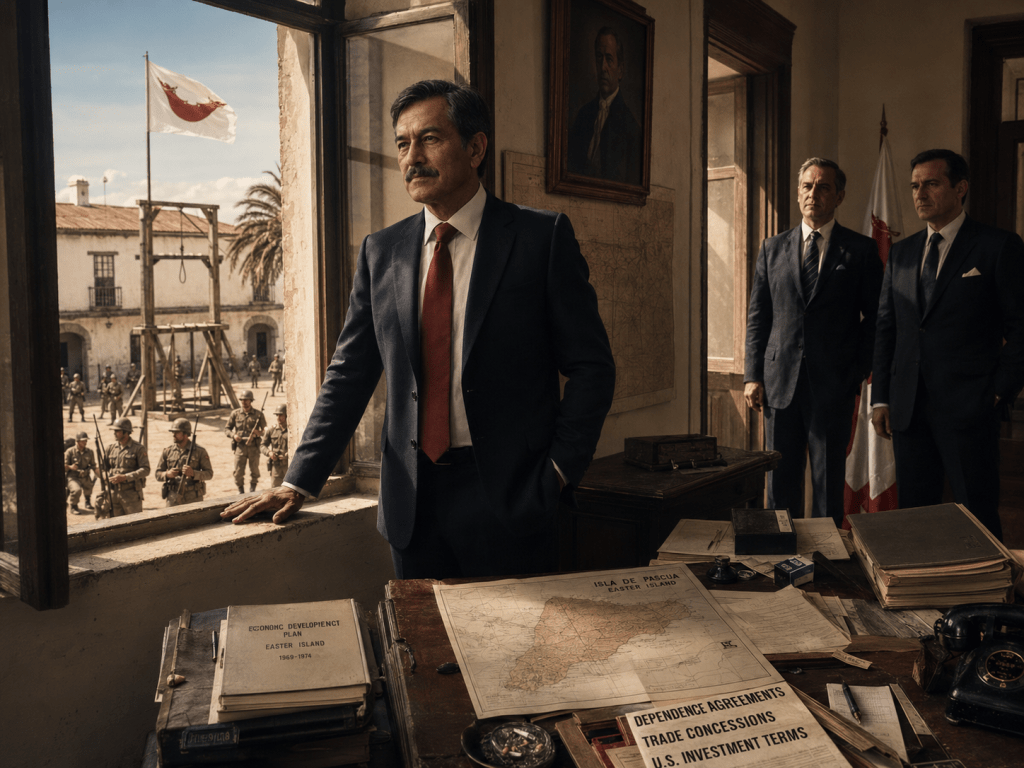
Rapu stopped before a window overlooking the courtyard. The scaffold was ready. He repeated to himself that the execution was necessary. Justice had to be visible. The revolution must not appear weak. And yet he recoiled, slightly, at the sight of it. He had not imagined that independence would begin with a hanging.
An adviser approached cautiously.
“Mr. President,” he said in a measured voice, “the turnout for the housing allocation is lower than expected.”
“How low?”
“Thirty houses.”
Rapu turned slowly.
“Out of three hundred available?”
“Yes.”
A long silence followed.
Rapu went back to the desk and placed both hands on its surface. Three hundred. He had expected at least half the island to rush toward the opportunity, toward proper homes, wages, organization, normality. Instead they were hesitating. Or refusing.
“Are they afraid?” he asked.
“They are loyal,” the adviser replied carefully. “To Hotukau.”
That name tightened Rapu’s jaw.
Hotukau.
A man of memory.
A man of resentment.
A man incapable of governing by modern standards.
Rapu moved toward the balcony and looked at the soldiers preparing the courtyard.
“How can they turn this down?” he murmured. “We offered stability. Work. Infrastructure.”
“They do not trust you,” the adviser said.
Rapu exhaled sharply.
“They do not trust what? Beds? Salaries?”
“Your control.”
The word landed heavily.
Rapu straightened. He turned toward the adviser.
“They will come to work,” he said quietly. “I am certain of it.”
The adviser hesitated.
“The plantations are empty.”
Rapu’s expression changed.
“They are refusing?”
“Yes. A strike.”
For an instant, anger flashed.
“Then send the soldiers.”
The adviser shook his head gently.
“They are protected.”
“By whom?”
The question did not need an answer.
Hotukau.
Rapu returned to the window and stared toward the far edge of town, where the ghetto began.
The ground had shifted beneath him.
Not fear.
Not exactly.
A loss of narrative control.
He had believed independence would resolve the tension. Instead, it had only redistributed it.
III
President Sergio Rapu had imagined power differently. Not like this.
The plantations were silent. Rows of tobacco leaves trembled in the wind, unharvested. The machinery was still. The trucks sat idle in the mud. The hospital was overcrowded with soldiers, laborers, even civilians injured in the unrest. The smell of antiseptic mingled with sweat and iron.
Revolutions are supposed to move forward.
This one had stalled.
Rapu stood at the window of his office, looking out over the courtyard that only a few days earlier had echoed with gunfire. The palace was his now. The desk was his. The flag outside was his.
And yet the island did not feel like his.
His backers had invested heavily in those plantations. Infrastructure. Equipment. Seeds. Engineers. Security. On paper, the numbers were clean. Now the numbers were bleeding. They had also invested heavily in the search for the Mystery. But, thank God, he trusted the American archaeologists more than his own people.
He pressed his fingers to his temple. He had built his fortune selling tropical fruit, shipment after shipment, negotiated through long nights and even harder mornings. He had worked. Always worked. Nothing had ever been given to him.
His father had been a police officer in Chile. Underpaid. Invisible. A man who believed in order because order was the only way a poor man survived. When opportunities dried up, he had been assigned to Easter Island. It was supposed to be temporary. There he met Rapu’s mother. She too came from poverty, real poverty. They married and built a family on discipline. On sacrifice. Rapu had grown up believing that effort was dignity. Now, in the streets, he heard the word rights shouted more often than work.
He did not hate his people.
But he did not trust their romanticism.
Freedom without productivity collapses.
He believed that completely.
He turned back toward the desk.
Debt.
That was the true tyrant.
A knock at the door, then a guard entered without waiting for permission.
“Mr. President, the American businessmen are here.”
Rapu went still for a moment.
Of course.
The unrest had reached Santiago. Santiago had reached Washington. Washington had reached them.
“Show them in,” he said calmly.
He straightened his tie. Composure first. Always composure.
Two tall men entered, dressed in dark suits despite the heat. They did not smile. They did not remove their jackets.
They did not need to.
They sat without waiting for a second invitation.
“Mr. President,” one of them said in a soft but cold voice, “we came as soon as we learned that the situation was… unstable.”
Unstable.
Rapu forced a courteous expression.
“I assure you, gentlemen, this is a temporary phase.”
The second man leaned forward.
“When we invested in tobacco production here, you projected annual revenue of two million dollars.”
A pause.
“Our engineers estimate current losses at approximately one thousand dollars a day.”
He let the number hang in the air.
“And rising.”
Rapu felt the weight of the room shift.
He had convinced them once.
He had promised stability.
He had promised labor.
He had promised alignment with American interests.
He had promised efficiency.
“We are in a period of transition,” Rapu replied. “The repression of the previous administration generated instability. My government is reorganizing labor structures.”
The first man folded his hands.
“Mr. President, we did not finance a transition. We financed reliability.”
The second added quietly:
“Remember that our financial support was not exclusively commercial.”
There it was.
The unspoken part.
The resources that had helped him overthrow Chilean authority.
The diplomatic silence that had favored his rise.
The weapons discreetly passed through certain channels.
The American businessmen had not invested out of charity.
They had invested for influence.
“We need guarantees,” said the first. “Productivity. Security. Loyalty.”
Rapu’s throat tightened slightly, but his face remained controlled.
“And if I cannot guarantee them immediately?” he asked.
The two men exchanged a glance.
“The Pentagon,” the second said carefully, “has authorized the dispatch of a small protective unit. A preventive measure.”
“A garrison?” Rapu asked.
“A stabilizing presence.”
“How many?”
“One hundred initially. Perhaps more, if necessary.”
Foreign troops.
On soil that had just declared its independence.
The irony was sharp enough to taste.
The first man leaned back.
“You understand, Mr. President, that democracy requires structure.”
Rapu understood.
Democracy requires structure.
Structure requires discipline.
Discipline requires force.
He rose and moved slowly back to the window.
Outside, the courtyard looked deceptively calm.
He thought of Hotukau.
The old king in the ghetto, with his drums and his wounded mythology. The island loved men like that, even when they lived inside contradictions. A man of God supported by atheist Russians? The island trusted scars more than elegant suits.
Rapu did not consider himself a tyrant. He considered himself modern.
The island could not remain a museum of suffering. It needed roads. Hospitals. Export routes. Capital. Growth. But growth demanded order. Order demanded authority.
He felt the trap closing. If he allowed the American troops to land, Hotukau would call him a traitor. If he refused, his backers would crush him economically. He was no longer fighting Chile. He was balancing empires.
Behind him, the Americans stood up.
“We expect progress within a few days,” one of them said.
They shook his hand again. Firmly. Not warmly.
When they left, the office felt emptier but heavier. Rapu returned to the desk. He opened a ledger and stared at the columns of figures.
Debt.
Security.
Labor shortages.
Unrest.
A governor’s wife wounded.
A ghetto chanting death.
He whispered to himself:
“I did it for progress.”
But the word sounded fragile.
He remembered his father polishing his uniform in silence. Order first. Emotion later.
He remembered his mother counting coins at night.
Hard work. No excuses.
Was he betraying them by yielding to foreign pressure?
Or was he protecting the island from economic collapse?
Outside, in the distance, the drums echoed faintly across Hanga Roa.
He closed his eyes and saw him again.
Hotukau.
 Marco Di Caprio
Leave a comment