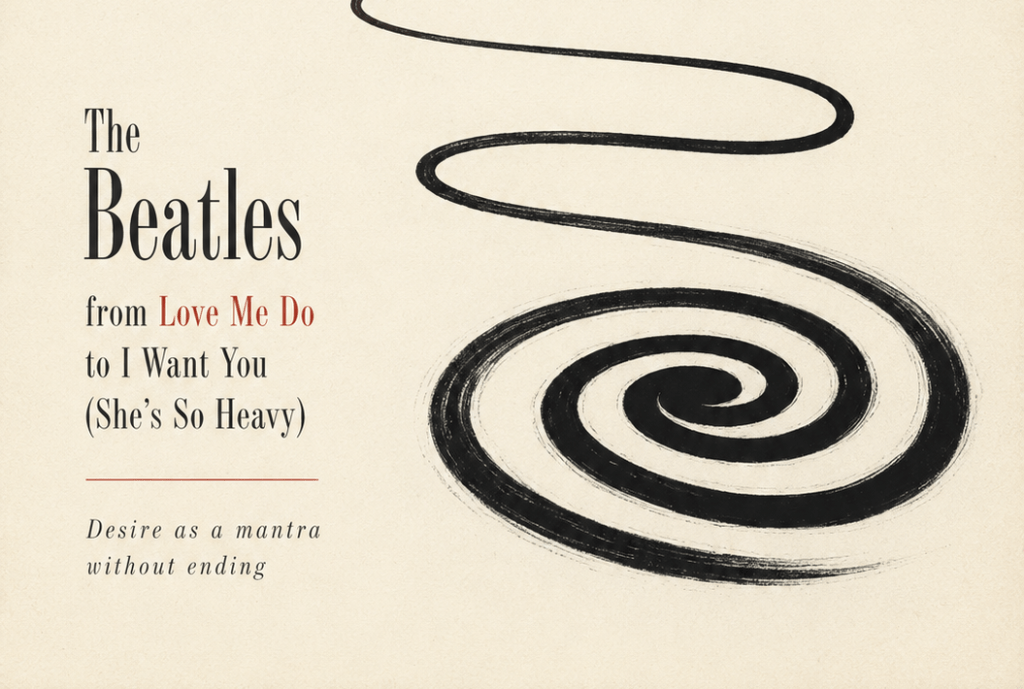
There is a strange line connecting “Love Me Do” (1962) and “I Want You (She’s So Heavy) from 1969. On the surface, they seem to belong to two completely different worlds. One is young, bright, simple, almost shy. The other is dark, heavy, hypnotic, almost frightening.
But both songs are built around the same thing: desire repeated until it becomes a mantra.
In “Love Me Do,” desire is still related to teenage love. The lyrics are very simple and repetitive: love me, do. The song has the simplicity of someone who has not yet learned how complicated love can become.
The repetition is important. The phrase comes back again and again, almost like a spell. It is as if the singer believes that, by repeating the request, love might finally answer. The song does not really reach a conclusion, but it stays open, suspended, waiting.
So “Love Me Do” is already a mantra, but a hopeful one. It is the sound of desire before pain has transformed it.
With “I Want You (She’s So Heavy),” the same idea returns, but in a much darker form. The words are still simple: I want you. Yet now the simplicity feels dangerous, because it is no longer the innocent request of someone asking to be loved. It is the voice of someone trapped inside a relationship.
The repeated line becomes obsessive. It does not open toward love; it closes in on itself.
The ending is not slow, but sudden. The song does not resolve.
In both songs, desire is unfinished. But in the first song, that lack of ending feels like possibility, joy and hope. In the second, it feels like a trap.
From “Love Me Do” to “I Want You (She’s So Heavy),” the Beatles show how desire can change over time. It begins as a simple call for love and ends as an obsessive force that almost destroys the mind. What starts as pop innocence becomes psychological weight.
The mantra remains.
But the light has turned into darkness.
Marco Di Caprio
 Marco Di Caprio
Leave a comment