I
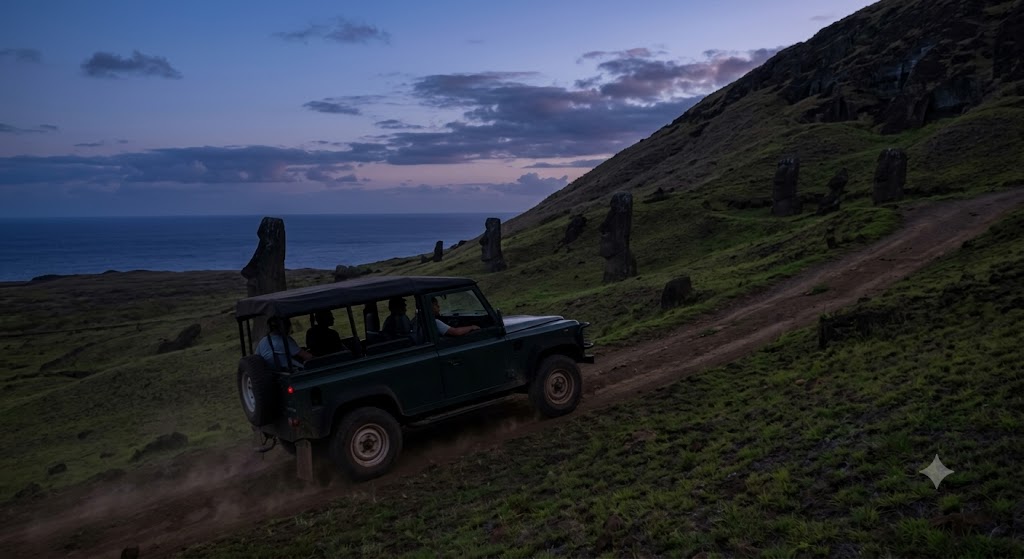
A jeep crawled forward across the uneven volcanic ground, its tires slipping slightly over hardened lava and dry grass. The engine growled low, then steadied, then growled again.
Dusk was descending, not suddenly, but deliberately.
Poike rose before them, broad and patient, its long slope absorbing the last diluted light of the sun. The sky behind it burned in fading amber, dissolving into violet above the restless sea. The air carried the smell of salt and something metallic with the quiet promise of changing weather.
Mario stared at the horizon without speaking.
Patrick drove with measured calm, both hands steady on the wheel.
Neither of them mentioned Jerry. Neither mentioned the phone call.
They parked near a narrow strip of beach at the base of the slope. The engine died. The sudden silence pressed gently against their ears.
The waves were stronger now than before. Not violent but insistent.
“Storm later,” Mario said quietly.
“Perhaps,” Patrick replied.
They began the climb.
The path was narrow, carved into the hillside by years of footsteps and wind. Dry grass brushed against their trousers. Volcanic stones shifted under their boots.
Halfway up, the house appeared.
It was simple, wooden, sun-worn, leaning slightly as though it had grown out of the hillside itself. A small fenced field stretched behind it. A few cattle grazed lazily in the fading light, their dark shapes against the sky.
At the entrance, seated on a low wooden chair, was Ariki.
He did not seem surprised.
He sat motionless, facing the ocean, his long white beard moving slightly in the wind. A cat lay curled on his knees, asleep, its body perfectly still except for the slow rhythm of its breathing. One of Ariki’s hands rested upon it, his fingers moving absentmindedly through its fur in small unconscious gestures.
He did not look at them immediately.
Only when their steps reached the gravel in front of the house did he lower his gaze.
He measured them in silence.
Patrick inclined his head slightly.
“Master Ariki.”
Mario instinctively extended his hand.
The old man’s eyes dropped to it. The cat stirred slightly, lifting its head just enough to observe the newcomers. Ariki made no movement to shake hands.
Mario slowly withdrew his hand, feeling vaguely foolish.
“Why are you here?” Ariki asked at last. His voice was dry, but not hostile.
“It’s always good to see you,” Patrick replied calmly.
Ariki narrowed his eyes.
“Did you bring me cigarettes, Patrick?”
Patrick hesitated.
“No.”
A faint sound escaped Ariki’s throat.
“You always forget.”
He bent slightly with his free hand and lifted a bottle of beer resting on the ground beside him.
“Want one?”
“No, thank you,” Patrick replied. “We won’t take much of your time.”
“I’m not worried,” said Ariki, sipping slowly. “You’re always the one in a hurry.”
The cat stretched, shifted position, and settled again without fear.
To Ariki, Mario seemed not to exist.
The wind changed direction, brushing the walls of the house with a low murmur.
Patrick slipped a hand inside his jacket and pulled out a folded sheet of paper.
“I need your help, Master.”
Ariki did not immediately extend his hand.
“For what?”
Patrick carefully unfolded the sheet, the transcription of the Rongorongo tablet, and held it out to him.
Ariki adjusted the cat slightly before accepting the paper. The animal did not protest; it seemed to trust the old man’s steady body.
He read.
The first lines brought a faint smile.
At the second movement of the poem, the smile vanished.
By the final stanza, his eyes had narrowed into thin slits.
The light grew thinner.
Ariki read again, more slowly.
“The priest who wrote this survived the great war,” he said at last.
His voice had changed, not dramatic, but distant.
“When the aristocrats were defeated, some priests fled into the caves. Some took boats and disappeared. One remained.”
Patrick remained silent.
“He guarded the knowledge,” Ariki continued. “He trusted no one.”
“The Rongorongo script?” Patrick murmured.
“Yes.” Ariki lifted his gaze. “The writing of the elite. Not for peasants. Not for rebels. Not for the impatient.”
His eyes flickered briefly toward Mario.
“Power,” he said softly, “lives in what others cannot decipher.”
The cat moved again, lifting its head to glance toward Mario before curling back into the warmth of Ariki’s knees.
Mario felt heat rise behind his ribs.
“We found the treasure,” he said. “And the riddle inside it.”
Ariki folded the sheet deliberately.
“Do you think it makes you worthy of finding the Mystery?”
Mario hesitated.
“If you know where it is,” he replied a little too quickly, “why don’t you tell us?”
Patrick’s foot brushed lightly against his.
Ariki observed the exchange without irritation.
“You are impatient,” he said. “Young people always are. I was no different.”
Ariki had been born into one of the wealthiest families of Rapa Nui, raised from childhood in the discipline of spirit and ritual. For years he had served as the spiritual advisor to King Hotukau, until their disputes over an alliance with the Russians had driven him into exile.
He leaned back slightly, absentmindedly stroking the cat.
“I do not know where the Mystery lies,” he continued. “And if I did, I would not place it in the hands of those who seek it only with force.”
Mario stiffened.
“We are scholars,” he insisted. “We seek understanding.”
Ariki’s gaze sharpened.
“You seek possession and prestige.”
The wind grew sharper along the slope.
“The ancient priest was dying,” Ariki continued. “He believed those who would survive him were not ready. So he divided the path.”
“Divided?” Patrick asked.
“He scattered clues. Fragments. Other tablets. Each marked with the toromiro leaf. A plant native to the island. Only those who understood the spirit behind the ancient words would be worthy.”
The sky deepened into indigo.
“We have the first fragment,” Mario said more quietly now. “Perhaps we must break the bottom of the chest to find the second tablet.”
Ariki smiled faintly.
“You wish to break the wood before refining the spirit.”
The words were gentle, almost benevolent.
“You may break the wood,” he said. “You may find what lies beneath. But without spiritual refinement, you will see only clay.”
The cat opened its eyes fully and gazed toward the fading light.
The island was growing darker.
Patrick bowed again. The wise Ariki made a small shrugging gesture with his shoulders. But his eyes remained fixed on Mario as the two archaeologists turned to leave.
As Mario descended the path beside Patrick, the wind colder now, he felt something unusual. It was not discouragement, nor triumph.
Something closer to having been examined.
Below them, the sea struck the rocks again and again.
Behind them, Ariki remained seated, the cat still calm upon his knees.
II
They descended the slope slowly.
The fog had thickened. It slid down the hillside in pale ribbons, catching the moonlight before dissolving again. The path was harder to see now. Stones shifted beneath their boots.
For a while neither spoke.
The house above them had already vanished into shadow.
Mario broke the silence.
“Why didn’t you challenge him, Professor?”
The tone was light, but the edge was visible.
Patrick kept his eyes on the path.
“About what?”
“You let him give us his sermons,” Mario exhaled softly. “Were you afraid of offending him?”
Patrick did not answer.
Mario gave a faint smile. The fog softened the gesture.
“He speaks as if we were fools. He doesn’t know I’ve studied Eastern philosophy. Detachment from the world isn’t new to me.”
Patrick glanced briefly at him.
“He doesn’t think we’re ignorant,” he said. “He thinks we’re not spiritually ready.”
They walked a few more steps in silence. The sound of the sea below them rose and fell with the wind.
“He’s stubborn,” Mario continued. “But I think he’s sincere when he says he doesn’t know where the Mystery is.”
“Yes.”
“You could have challenged his beliefs,” Mario insisted.
Patrick stopped for a moment and turned slightly toward him.
“Why demolish a man’s certainties,” he asked quietly, “when you have none to replace them?”
The fog drifted between them like a thin veil.
“We study spirituality,” Patrick continued. “He lives it.”
They resumed walking.
Mario felt a restless energy rising within him.
He had always been fascinated by men like Ariki, men capable of withdrawing from the noise of the world without feeling diminished. Ascetics. Hermits. Figures who chose solitude without fear.
It seemed like courage.
Radical courage.
To sit on a hillside with a cat on your knees while the island tore itself apart below.
Part of him envied that stillness.
Part of him feared it.
He could not imagine a life without voices, without faces, without movement. Without the constant need to measure himself against others.
For him, solitude did not taste like peace.
It tasted like memory. The memories of his traumatic childhood. The memories of someone afraid to love.
He quickened his pace slightly, then slowed again.
Study had always been safer.
Books do not abandon you. Archives do not leave. Texts do not fall silent.
He had built his refuge carefully, page by page.
Better to analyze hundreds of manuscripts than face the void.
The sea roared beneath them now.
Patrick walked beside him without speaking, perhaps sensing more than Mario had intended to reveal.
At the base of the slope, the jeep appeared through the fog, solid, mechanical, reassuring.
Mario turned once toward the invisible house above them.
The old man would still be sitting there.
Still stroking the cat.
Unperturbed.
The Mystery, he realized, might demand qualities he did not yet possess.
And that thought disturbed him more than any riddle carved in clay.
III
They descended from Poike and reached the jeep in silence.
The fog had followed them down the slope, clinging to the grass, dissolving against the darker shapes of volcanic rock. The sea struck the rocks with a heavier rhythm now.
Mario started the engine.
The headlights carved a pale tunnel through the growing darkness.
They drove along the coast.
The road was uneven but familiar. A strip of packed earth between the ocean and inland fields. Palm trees formed thin silhouettes against the dull horizon. The narrow beach shimmered faintly under the first hint of moonlight.
For a while neither spoke.
Patrick sat with his hands loosely folded in his lap.
Mario drove faster than necessary.
The jeep passed through a small palm grove. Shadows shattered across the windshield like broken fingers. Beyond the grove opened a wide plain where the wind ran freely across dry grass.
They slowed slightly.
Hanga Roa appeared in the distance as a cluster of flickering lights on the horizon.
Then they heard it.
At first it was faint.
Not drums.
Not music.
A scream.
Then another.
The sound did not belong to celebration.
Mario and Patrick exchanged a glance. Mario pressed harder on the accelerator.
As they approached the outskirts of the village, the air thickened with noise, shouts, whistles, fragmented cries, footsteps running over gravel.
Something had broken.
They turned onto the dirt road leading to the main street.
A crowd had gathered ahead.
Police lanterns flickered unevenly. Figures moved in broken silhouettes. Someone was shouting in Spanish.
Mario braked sharply.
“What happened?” he shouted toward a uniformed officer.
“An accident,” the policeman replied curtly. “You can’t pass.”
But the tone was wrong.
This was not the noise of protest.
It was panic.
Patrick stepped out first. Mario followed without waiting.
They pushed through the mass, shoulders, elbows, fragments of faces lit by unstable light.
Then the circle opened.
And the world narrowed.
Jerry lay on the ground.
On his back.
Blood had spread beneath him, dark and reflective in the lantern light. It pooled unnaturally around his abdomen.
For a second Mario did not understand what he was seeing.
Then he did.
He dropped to his knees.
“Jerry.”
His voice did not sound like his own.
Patrick stood frozen for only an instant before crouching on the other side.
Jerry’s eyes were open.
He was still conscious.
Barely.
Mario grabbed his hand. It was cold, too cold.
“What happened?” he whispered. “Who did this to you?”
Jerry tried to breathe. Each breath was shallow, broken. His lips moved.
Mario leaned closer.
“An ambulance is coming,” he said desperately, though he had no certainty of it. “Stay with me.”
Jerry formed a faint smile, almost incredulous.
Mario felt hollowed out.
“Who shot you? The islanders?” he asked, his voice trembling now.
Jerry’s gaze shifted briefly, not toward Patrick, not toward the crowd, but toward the sky.
“Not the islanders,” he breathed. “It’s those… bastards. They want…”
His body jerked.
The sentence never finished.
“Who?” Mario insisted. “Who wants what?”
Jerry tried again.
“Go back… to America…”
The last syllables dissolved into the air. His head fell slightly to the side.
The light left his eyes opened, with no light inside.
Mario remained motionless, still holding his hand.
For the first time, Patrick saw him stripped of irony, stripped of detachment.
The police moved closer.
“Back. Back.”
Patrick placed a hand on Mario’s shoulder.
“It’s over.”
Mario did not answer. He stared at Jerry’s face as if waiting for a correction. As if it were a translation mistake.
Two officers pulled him up by force.
He resisted for a moment, then gave in.
The crowd began to disperse.
The sirens arrived too late.
 Marco Di Caprio
Leave a comment